CP Christopher Paul Back to home
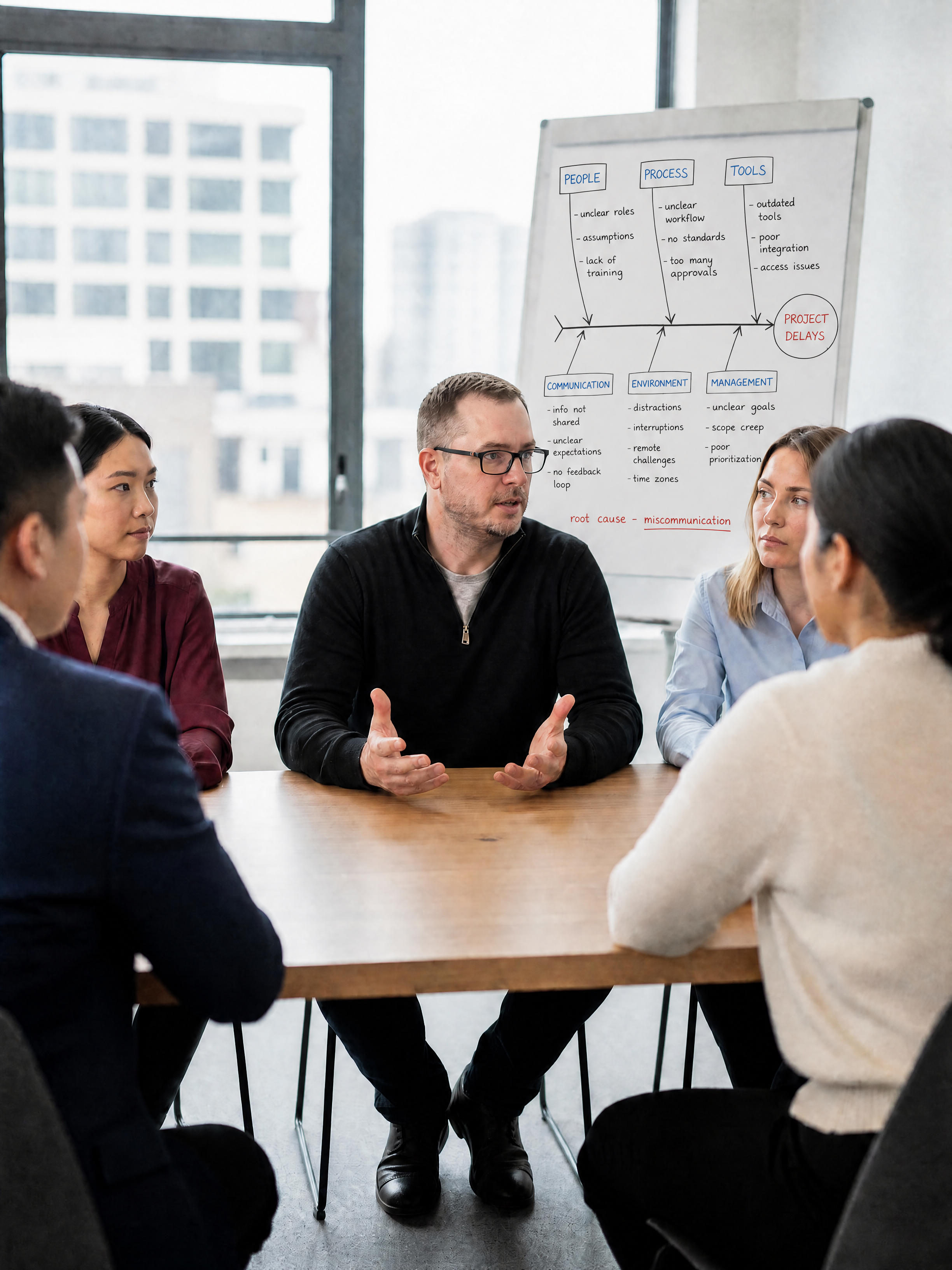
Christopher Paul leading a working session with his team
My Approach · Operating Model

How I turn business problems into measurable results.

My work starts with the business problem, not the training request. I use a structured operating model to clarify the real need, align stakeholders, design practical solutions, and measure whether the work changed readiness, behavior, performance, or cost.

01

Diagnose

Find the outcome that's hard to move and baseline the real cause with data the business already trusts, before designing anything. Separate the stated request ("we need training") from the actual performance gap.

Risk it reduces

Spending budget on training that never addresses the real driver of the gap.

Example output

Problem statement, baseline, and success metrics identified up front.

02

Architect

Design the learning strategy, role-based curriculum architecture, and governance model: the structure that lets learning scale, stay consistent, and survive an audit.

Risk it reduces

Fragmented, inconsistent, non-compliant learning that can't scale or hold up to scrutiny.

Example output

Role-to-curriculum map and a governance operating model.

03

Align

Build cross-functional agreement with stakeholders, affected business areas, and project leadership. Frame the business need, surface tradeoffs, and use data and logic to align stakeholders without formal authority.

Risk it reduces

Stalled rollouts and rework from stakeholders who were never bought in.

Example output

Stakeholder RACI, intake model, and an executive-approved scope.

04

Execute

Lead content development, approvals, vendor coordination, and quality standards to keep delivery on target and within requirements across languages and locations as needed.

Risk it reduces

Missed deadlines, quality drift, and runaway cost.

Example output

A single design standard held across every course, language, and location.

05

Measure

Use Kirkpatrick-informed measurement where it fits the work, from reaction and learning to behavior and business results, and report signals leadership can trust, traceable to systems the business already runs on.

Risk it reduces

Investment with no evidence of behavior change or business impact.

Example output

Executive scorecard: readiness, capability, satisfaction, and ROI.

06

Optimize

Reduce cost and outside dependence, modernize workflows with AI as a practical enabler, and sustain the gain so results hold once the cross-functional project team moves on.

Risk it reduces

Erosion of results and rising spend once attention moves elsewhere.

Example output

Lower program spend and reduced vendor dependence, sustained year over year.

The takeaway

It's a loop, not a line.

Optimize feeds back into Diagnose. Each cycle raises the baseline: readiness improves, cost drops, and the operating model gets sharper. That's how a one-time program becomes a durable capability the business keeps.

It moves at the speed of the request.

The model scales to the work, giving fast-moving projects enough structure without slowing them down.

One model, different work

How the model flexes.

The same six stages run underneath every engagement. What changes is where the weight lands.

Transformation work

Weight shifts to Architect and Align: role-based structure and stakeholder agreement carry readiness through a system change without disrupting operations.

Leadership development

Weight shifts to Diagnose and Measure: clarify the behavior to change, then track whether it actually shows up in how people lead.

Compliance learning

Weight shifts to Architect and Measure: governance, traceability, and evidence have to hold up to audit, not just completion counts.

Learning operations

Weight shifts to Execute and Optimize: process, quality standards, and cost discipline keep delivery consistent and sustainable at scale.

In practice

How this shows up in real work.

The model is only as good as the judgment behind it. A few ways the discipline shows up once the work gets complicated.

Balancing speed, governance, and learning quality when the business needs all three at the same time.

Aligning HR, IT, Quality, Change, Operations, and business stakeholders around one set of readiness outcomes.

Translating ambiguous requests into clear, measurable readiness outcomes the business can act on.

Managing regulated-environment learning constraints without adding friction for the learner.

What's next

See what this approach has produced.

The operating model is designed to turn complex learning problems into practical systems, clearer readiness, and measurable results.